
Egg Freezing: Who Should Consider It?
Egg Freezing: Who Should Consider It?
Egg freezing, medically known as oocyte cryopreservation, is a fertility-preservation technique in which a woman’s mature eggs are collected, frozen, and stored for possible use in the future. When the eggs are needed, they can be thawed, fertilized through IVF, and used to create embryos.
Egg freezing can provide an additional reproductive option for some women, particularly when future fertility may be affected by medical treatment or when someone wants to preserve reproductive potential while postponing pregnancy. However, it is not a guarantee of having a baby, and age at the time of freezing is an important factor in future outcomes.
What Is Egg Freezing?
Egg freezing involves preserving a woman’s unfertilized eggs at a low temperature so they can potentially be used later.
Unlike embryo freezing, the eggs are frozen before fertilization, meaning sperm does not need to be selected or used at the time of freezing. This can give the person who freezes the eggs control over the future choice of sperm source.
The technique used today is generally vitrification, a rapid freezing method that helps prevent damaging ice crystals from forming inside the egg.
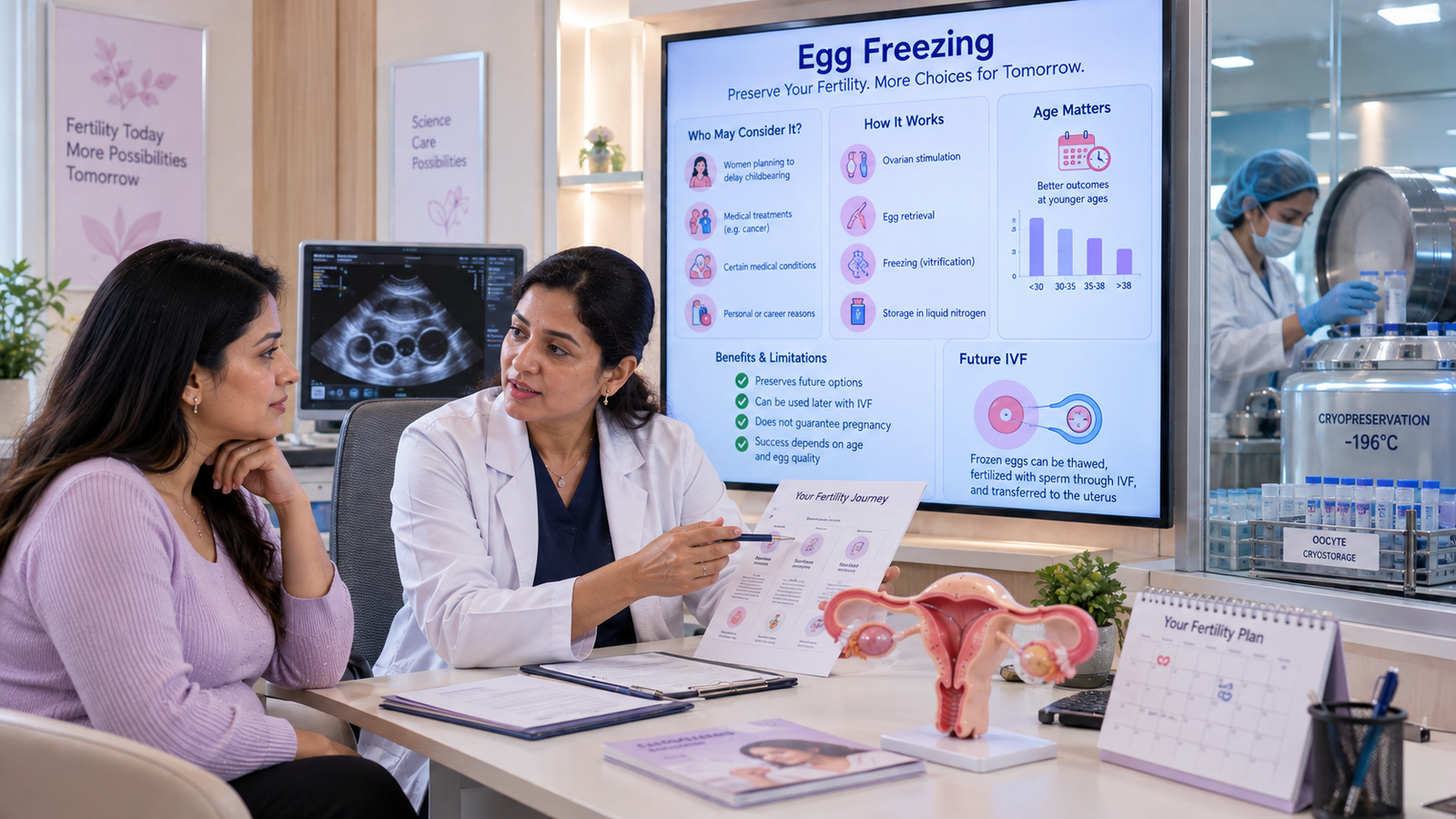
Who Should Consider Egg Freezing?
Egg freezing may be considered in several situations.
1. Women Undergoing Cancer Treatment
Some cancer treatments, including certain chemotherapy or radiation treatments, can damage the ovaries and affect future fertility.
When treatment could significantly affect fertility, egg freezing may be discussed as part of fertility preservation before treatment begins.
Because cancer treatment can sometimes need to start quickly, fertility-preservation discussions should happen as early as possible.
2. Women Who Want to Delay Childbearing
Some women may choose egg freezing because they are not currently ready to have children but want to preserve the possibility of using younger eggs in the future.
Reasons may include personal, relationship, educational, or career circumstances. Planned egg freezing is an individual reproductive decision and should involve clear counseling about its benefits, limitations, costs, and uncertainties.
3. Women With a Medical Condition That May Affect Fertility
Certain medical conditions or planned treatments can potentially reduce ovarian function or future fertility.
In these situations, a fertility specialist may discuss egg freezing or other fertility-preservation options depending on the individual circumstances.
4. Women Facing Potential Decline in Fertility
Fertility naturally changes with age, and egg number and quality decline over time. Freezing eggs at a younger age may preserve eggs before some age-related decline occurs.
However, professional guidance does not establish one single ideal age that applies to every woman. Decisions should be individualized based on age, reproductive goals, ovarian reserve, medical history, and the patient’s circumstances.
Why Does Age Matter in Egg Freezing?
Age at the time eggs are frozen is one of the most important factors influencing future outcomes.
In general, younger eggs are more likely to have better reproductive potential than eggs collected at older ages. ASRM’s evidence review found that outcomes appear better when oocyte cryopreservation is performed at a younger age, although available evidence is limited and there is not enough evidence to define one universal optimal age.
This is why a fertility consultation should focus on your age and your individual reproductive circumstances, rather than relying on a single age cutoff.
How Does Egg Freezing Work?
Step 1: Fertility Assessment
Your fertility specialist reviews your medical history and reproductive goals and may recommend tests to assess ovarian function and determine an appropriate treatment plan.
Step 2: Ovarian Stimulation
Hormonal medicines are used to stimulate the ovaries so that multiple eggs can mature during one treatment cycle.
Step 3: Monitoring
Ultrasound examinations and blood tests may be used to monitor follicle development and hormone levels during stimulation.
Step 4: Egg Retrieval
When the eggs are mature, they are collected from the ovaries through a procedure performed with sedation or anesthesia.
Step 5: Freezing
Mature eggs are rapidly frozen using vitrification and stored in liquid nitrogen for possible future use.
What Happens When You Want to Use Frozen Eggs?
When you decide to use the eggs, they are thawed and assessed for survival.
The surviving eggs are generally fertilized using intracytoplasmic sperm injection (ICSI). The resulting embryos can then be cultured and transferred to the uterus as part of IVF treatment.
Not every frozen egg will survive thawing, fertilize, develop into an embryo, or result in a pregnancy.
Benefits of Egg Freezing
Possible benefits include:
Preserving Younger Eggs
Eggs are preserved at the age when they are collected, which may be useful because egg quality declines with age.
Greater Future Flexibility
Egg freezing can provide an additional option for women who are not ready to pursue pregnancy immediately.
Fertility Preservation Before Medical Treatment
It can be an established option for fertility preservation when medical treatment may damage ovarian function.
Future Choice of Sperm Source
Because the eggs are not fertilized when frozen, the future sperm source can be chosen when the eggs are used.
Is Egg Freezing a Guarantee of Pregnancy?
No.
Egg freezing preserves eggs; it does not guarantee a future pregnancy or live birth.
Future success depends on several factors, including:
- Age when the eggs were frozen
- Number of mature eggs stored
- Egg survival after thawing
- Fertilization
- Embryo development
- Uterine and overall reproductive health
ASRM recommends discussing clinic-specific success rates and uncertainties with patients considering planned egg freezing.
What Are the Risks of Egg Freezing?
Egg freezing involves ovarian stimulation and an egg-retrieval procedure, so it has potential risks and side effects.
These may include:
- Bloating
- Abdominal discomfort
- Mood changes
- Injection-related discomfort
- Ovarian hyperstimulation syndrome (OHSS)
- Bleeding or infection related to egg retrieval, although serious complications are uncommon
Fertility medicines can, in some cases, cause OHSS, which can become serious and requires medical attention.
Your fertility specialist should explain the risks relevant to your health before treatment.
Why Choose Naari Women's Hospital?
At Naari Women’s Hospital, fertility care is personalized to each woman’s reproductive goals, age, medical history, and fertility needs. Our experienced team can guide you through fertility assessment, preservation options, egg-freezing procedures, and future family-planning considerations.