
Congenital Anomaly Scan:
A Detailed Guide for Expecting Parents
Level-2 / Congenital Anomaly Scan: A Detailed Guide for Expecting Parents
Pregnancy is a beautiful journey filled with excitement and curiosity about the baby’s growth and development. One of the most important medical tests during pregnancy is the Level-2 Scan, also known as the Congenital Anomaly Scan. This ultrasound plays a vital role in checking the baby’s overall development and identifying any possible abnormalities at an early stage.
Usually performed between 18 to 22 weeks of pregnancy, this scan provides a detailed look at the baby’s organs and physical structures. It helps doctors ensure that the baby is developing properly and allows early detection of potential health concerns.
What is a Level-2 / Congenital Anomaly Scan?
A Level-2 scan is an advanced ultrasound examination performed during the second trimester of pregnancy. Unlike the basic pregnancy ultrasound, this scan provides a detailed evaluation of the baby’s anatomy.
During the scan, doctors carefully examine the baby’s organs, bones, and overall growth to identify any congenital abnormalities (birth defects). The scan also helps confirm whether the baby’s growth matches the expected gestational age.
This test is completely safe, non-invasive, and painless, making it a routine but extremely important part of prenatal care.
Why is the Level-2 Scan Important?
The congenital anomaly scan is important because it helps doctors detect structural abnormalities early in pregnancy. Early diagnosis allows doctors and parents to plan proper medical care and management if required.
Some key benefits of the Level-2 scan include:
Detecting birth defects or structural abnormalities
Monitoring the baby’s organ development
Checking amniotic fluid levels
Evaluating the placenta position
Confirming the baby’s growth and movements
Early detection of any issue allows doctors to provide timely treatment, monitoring, or medical guidance, ensuring the best possible care for both mother and baby.
What Does the Level-2 Scan Check?
During the congenital anomaly scan, doctors carefully examine several important parts of the baby’s body.
1. Brain and Spine
The doctor checks the baby’s brain structure and spinal column to ensure they are developing normally and to rule out conditions such as neural tube defects.
2. Heart
The scan evaluates the baby’s heart chambers, heartbeat, and blood flow to detect any congenital heart defects.
3. Kidneys and Bladder
Doctors examine the kidneys and bladder to ensure proper development and normal urine production.
4. Face
The baby’s face is checked to identify conditions such as cleft lip or other facial abnormalities.
5. Hands, Legs, and Bones
The scan ensures that the baby’s arms, legs, fingers, and bones are developing normally.
6. Internal Organs
Other organs like the stomach, liver, and lungs are also examined to ensure proper formation and growth.
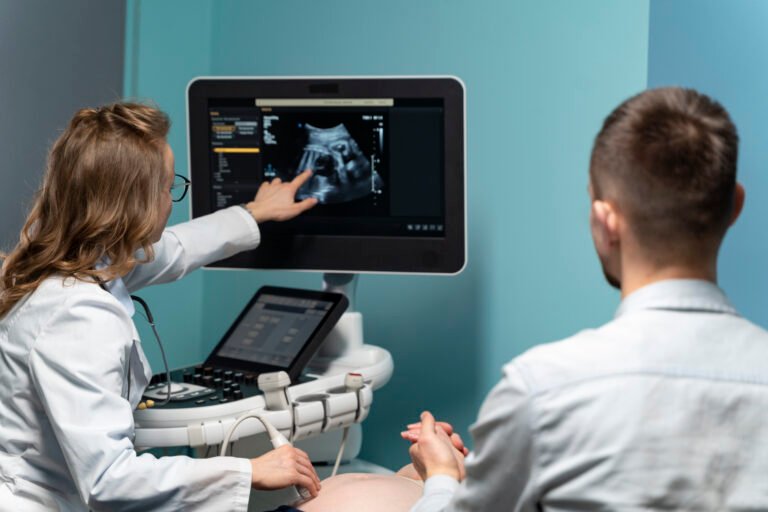
How is the Level-2 Scan Performed?
The Level-2 scan is performed using a high-resolution ultrasound machine. During the procedure:
The mother lies comfortably on an examination table.
A special gel is applied to the abdomen.
A small handheld device called a transducer is moved over the abdomen.
The ultrasound machine creates detailed images of the baby inside the womb.
The entire procedure usually takes 20 to 45 minutes, depending on the baby’s position.
Is the Congenital Anomaly Scan Safe?
Yes, the Level-2 scan is completely safe for both the mother and the baby. Ultrasound uses sound waves instead of radiation, making it a safe diagnostic tool during pregnancy.
It does not cause pain or discomfort, although sometimes the doctor may ask the mother to change positions to get clearer images of the baby
When Should You Get a Level-2 Scan?
Doctors usually recommend this scan between 18 and 22 weeks of pregnancy. This is the best time because the baby’s organs are developed enough to be clearly visible on ultrasound.
Getting the scan within this time frame helps ensure accurate assessment of the baby’s anatomy.
What Happens After the Scan?
After the scan, the doctor reviews the ultrasound images and prepares a report. In most cases, the results are normal and reassuring.
If the scan shows any abnormal findings, the doctor may recommend:
Further diagnostic tests
Specialized ultrasound
Consultation with a fetal medicine specialist
Early detection helps doctors provide the best possible care and guidance for the pregnancy.