
Laparoscopic Surgery: A Safe, Smart
& Scarless Treatment Option
Laparoscopic Surgery: A Safe, Smart & Minimally Invasive Solution
Medical technology has transformed the way surgeries are performed, making procedures safer, less painful, and quicker to recover from. One of the most significant advancements in modern medicine is laparoscopic surgery, also known as minimally invasive surgery or keyhole surgery.
Unlike traditional open surgery, laparoscopic surgery requires only a few small incisions, allowing patients to recover faster with less pain and minimal scarring. It has become a preferred treatment option for many gynecological conditions.
In this article, we’ll explain how laparoscopic surgery works, its benefits, common procedures, and what you can expect during recovery.
What Is Laparoscopic Surgery?
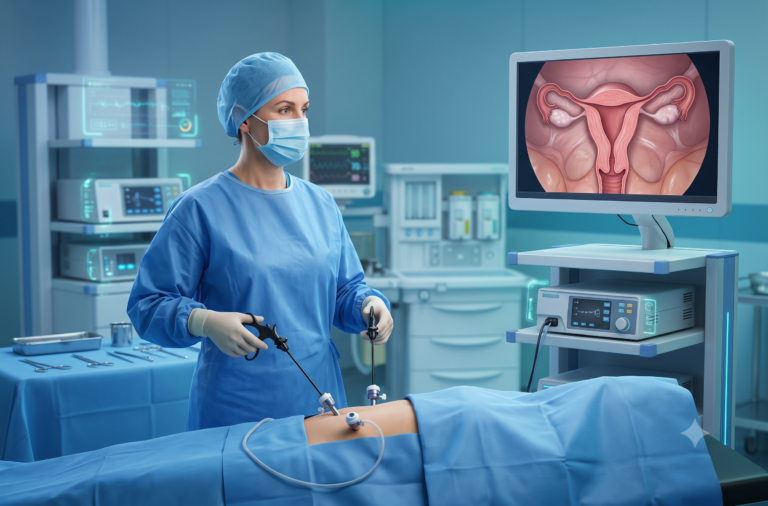
Laparoscopic surgery is an advanced surgical technique in which a surgeon performs an operation using a laparoscope—a thin tube with a high-definition camera and light attached to it.
The camera sends live images to a monitor, allowing the surgeon to perform the procedure through small incisions with great precision.
This technique reduces trauma to the body while improving surgical accuracy.
Benefits of Laparoscopic Surgery
Laparoscopic surgery offers several advantages over traditional open surgery, including:
Smaller Incisions
Only a few tiny cuts are required, resulting in less tissue damage.
Less Pain
Patients usually experience significantly less pain after surgery.
Faster Recovery
Most patients return to their normal routine much sooner than after open surgery.
Minimal Scarring
Small incisions heal quickly and leave little to no visible scars.
Reduced Blood Loss
The minimally invasive approach often leads to less bleeding during surgery.
Lower Risk of Infection
Smaller wounds reduce the chances of postoperative infection.
Shorter Hospital Stay
Many laparoscopic procedures allow patients to go home within 24 hours.
Common Gynecological Conditions Treated with Laparoscopic Surgery
Laparoscopic surgery is widely used to diagnose and treat various women’s health conditions, including:
Laparoscopic Hysterectomy
Removal of the uterus using minimally invasive techniques for conditions such as fibroids, heavy bleeding, or uterine prolapse.
Laparoscopic Cystectomy
Removal of ovarian cysts while preserving healthy ovarian tissue whenever possible.
Diagnostic Laparoscopy
Used to identify the cause of:
- Chronic pelvic pain
- Infertility
- Endometriosis
- Unexplained abdominal pain
Treatment of Endometriosis
Removes abnormal tissue growth and helps relieve pain while improving fertility outcomes in selected patients.
Fibroid Removal (Myomectomy)
Certain uterine fibroids can be safely removed using laparoscopic techniques.
When Is Laparoscopic Surgery Recommended?
Your gynecologist may recommend laparoscopic surgery if you experience:
- Persistent pelvic pain
- Ovarian cysts
- Endometriosis
- Uterine fibroids
- Heavy menstrual bleeding
- Infertility
- Ectopic pregnancy
- Chronic pelvic infections
What Happens During the Procedure?
The procedure generally follows these steps:
- General anesthesia is administered.
- Small incisions are made in the abdomen.
- Carbon dioxide gas gently inflates the abdomen for better visibility.
- A laparoscope is inserted to provide a clear view of the internal organs.
- Specialized surgical instruments are used to perform the procedure.
- The instruments are removed, and the incisions are closed with tiny stitches.
Most procedures are completed within 30 minutes to 2 hours, depending on the complexity.
Recovery After Laparoscopic Surgery
Recovery is generally faster compared to traditional surgery.
Most patients can:
- Walk within a few hours after surgery.
- Return home the same day or the following day.
- Resume light activities within one week.
- Return to normal work in approximately 1–3 weeks, depending on the procedure.
Your doctor will provide personalized recovery instructions based on your condition.
Is Laparoscopic Surgery Safe?
Yes. Laparoscopic surgery is considered a safe and effective procedure when performed by an experienced surgeon.
Like any surgical procedure, there are some risks, but complications are generally less common compared to traditional open surgery